
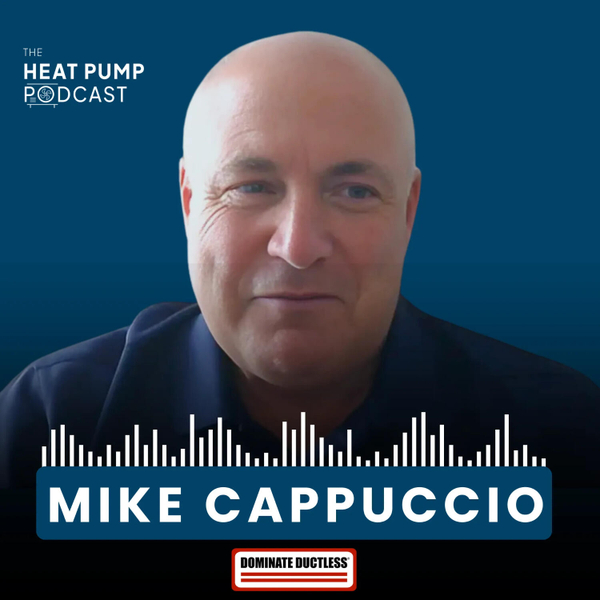
The Heat Pump Business Blueprint: Mike Cappuccio's Guide to Building a Company Worth Buying
- S1E32
- 57:39
- July 23rd 2025
Want to help build the future of heat pump software? We're hiring a software engineer to help contractors measure homes faster and design systems more accurately. Check out our open role. https://info.amply.energy/sr-mobile-engineer-may-2025
----------------------------------------
In this episode of the Heat Pump Podcast, Ed Smith welcomes back Mike Cappuccio, who built his HVAC company to over $15 million in revenue with 72 employees before selling to private equity in 2021. Now coaching contractors nationwide through Dominate Ductless, Mike shares the specific metrics, systems, and strategies that separate successful heat pump businesses from those that struggle.
Why Private Equity Was the Right Exit
While getting into the HVAC business is easy, getting out profitably is much harder. Many acquisition companies offer only 30% upfront with aggressive three-year earnouts contractors rarely achieve. Private equity offered Mike 95% upfront with minimal risk, though with the trade-off of giving up control: "The house was white, they painted it orange. But it's their house, not mine anymore."
The 6 Key Metrics Private Equity Firms Evaluate
- Revenue per employee: $250,000-350,000 annually (includes everyone from installers to office staff)
- Overhead costs and gross profit per work hour
- Revenue per salesperson: Target $300,000+ monthly, not the "horrible" $1M annually
- Revenue per service truck: At least $200,000 annually per vehicle
- Installation revenue metrics
- Number of maintenance agreements: Creates recurring revenue buyers love
The Four Essential Business Systems
Mike identifies four core systems separating thriving businesses from struggling ones:
System 1: Marketing, specifically problem-solution video marketing that documents real problems and solutions. Mike's YouTube videos continue helping customers years later.
System 2: Two-minute speed-to-lead response time makes customers 50 times more likely to choose you. Requires live weekend coverage and immediate online responses.
System 3: Defined sales process with 30-45 minute Home Comfort Surveys focusing on consultative selling rather than simple “box swaps”.
System 4: Price books and margin management that adjust for true overhead as companies grow.
Competing Against Low-Price Contractors
Mike's philosophy: "Knowledge is power." Educated contractors maintain advantages through financing capabilities, comprehensive discovery, and advanced technology demonstrations using tools like LiDAR and augmented reality.
Key Takeaways
For building better businesses:
- Track the six key metrics regardless of exit plans
- Implement the four essential systems early
- Specialize in heat pumps for operational advantages
For potential exits:
- Build systems that work without owner involvement
- Focus on recurring revenue through maintenance agreements
Timestamps:
[04:15] - Mike’s journey: scaling and selling his HVAC business
[11:49] - Key KPIs Private Equity investors care about.
[20:24] - Importance of maintenance agreements
[28:00] - Four core systems every contractor must build
[32:47] - Why fast response time (speed-to-lead) matters
[38:54] - How to compete against low-price contractors
[42:53] - Educated selling: show, don’t tell
[49:22] - Final thoughts: don’t give away value
Follow Mike Cappuccio
Follow Dominate Ductless
- Website: https://dominateductless.com/
- Facebook: https://www.facebook.com/Dominateductless/
- Twitter: https://x.com/d_ductless
- LinkedIn: https://www.linkedin.com/company/dominate-ductless/
- Youtube: https://www.youtube.com/@dominateductless
Follow the Hosts
- Ed Smith: https://www.linkedin.com/in/ed-smith-5aa8716
- Eric Fitz: https://www.linkedin.com/in/ehfitz/
- Amply Energy Website: https://www.amply.energy/
- Amply Energy YouTube: https://www.youtube.com/@amplyenergy
- Amply Energy Facebook: https://www.facebook.com/amplyenergy
- Amply Energy Instagram: https://www.instagram.com/amply_energy/
The Heat Pump Podcast
The Heat Pump Podcast discusses all things related to heat pumps. We cover:
- HVAC entrepreneurship
- Business operations
- Technology innovations
- Building science
- How policy impacts both contractors and homeowners
- ... and more
Our goal is to ensure that the transition to heat pumps for heating and cooling is a win for everyone – homeowners, contractors, and the planet – by sharing insights, learnings, and best practices.