
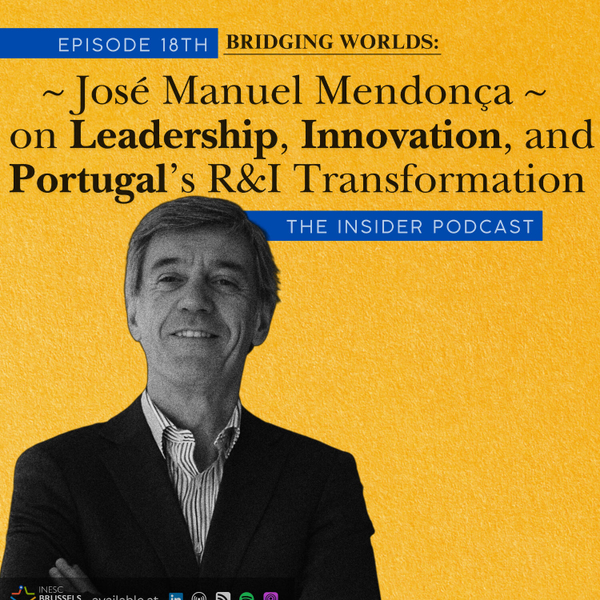
Bridging Worlds: José Manuel Mendonça on Leadership, Innovation, and Portugal’s R&I Transformation
- S1E18
- 57:39
- January 8th 2025
In this insightful conversation, Professor José Manuel Mendonça shares his journey from a young engineer in post-revolution Portugal to becoming a prominent figure in research and innovation.
He reflects on the challenges faced during his education, the cultural shocks experienced while studying abroad, and the lessons learned from martial arts that shaped his approach to leadership and resilience.
Mendonça emphasizes the importance of mentorship and the desire to implement change upon returning to Portugal, ultimately contributing to the development of renewable energy and research institutions.
In this conversation, José Mendonça reflects on his journey of learning from diverse sources, the evolution of research opportunities for young researchers, and the establishment of Inesq and InesqTech.
He discusses the cultural shift in Portugal towards a more European identity and the impact of this shift on research and innovation. The conversation also highlights the role of Inesq in European research projects and the challenges faced by the current generation of researchers.
Takeaways
- Portugal in the 1970s faced significant challenges in research and innovation.
- The Carnation Revolution opened new opportunities for young engineers.
- Studying abroad was a rare but transformative experience for Portuguese students.
- Denmark was a leader in wind energy, influencing Mendonça's career path.
- Mendonça's experiences abroad highlighted the differences in democracy and social harmony.
- Returning to Portugal, he aimed to apply his knowledge and experiences to improve the local research landscape.
- Mendonça's martial arts training instilled discipline, focus, and resilience in his professional life.
- The philosophy of 'be strong, be useful' guided Mendonça's approach to challenges.
- Mentorship played a crucial role in shaping Mendonça's leadership style.
- The DNA of an institution is formed by its people and their values. Learning can come from unexpected places.
- The importance of mentorship in personal growth.
- Current researchers have more resources but face greater challenges.
- Portugal's research landscape has significantly improved over the years.
- Young researchers must publish and have an impact to succeed.
- Cultural shifts influence institutional development.
- Inesq was pivotal in integrating Portugal into European research.
- Collaboration with European partners is essential for growth.
- The evolution of research opportunities reflects broader societal changes.
- Innovation requires a balance of ethics and practical application.
Chapters
00:00: The Journey Begins: Portugal's Transformation
01:38: Dreams and Challenges of a Young Engineer
04:25: Pursuing Education Abroad: A Leap of Faith
10:37: Cultural Shock: Learning from the UK and Denmark
17:43: Returning to Portugal: A Pragmatic Approach
24:46: Discipline, Focus, and Resilience: The Martial Arts Influence
35:20: Mentorship and Leadership: Influences Along the Way
36:56: Learning from Diverse Sources
39:01: The Evolution of Research Opportunities
44:32: The Genesis of INESC and INESC TEC
46:15: Portugal's Cultural Shift and European Integration
51:09: INESC's Role in European Research Projects
The Insider
Welcome to 'The Insider' your go-to podcast dedicated to providing an in-depth overview of EU Research and Innovation. I’m Ricardo Migueis, your host, and I'm excited to take you through the most relevant discussions and debates.
"The Insider" has two types of episodes:
1) The Insider Analysis: Deep dive into one topic. Deconstructing. Reflecting. Questioning. Opening the floor to new ideas. Constructive but bold. Searching for that delicate balance in public policy and R&I governance, funding dynamics. Whether you're a researcher, innovator, policy-maker, manager, lecturer, or simply someone passionate about R&I, this podcast is tailored just for you.
2) The Insider Interview: this is where we make in-depth analysis of specific policies, papers, books and other relevant themes in EU R&I. In a conversation with hand-picked guests, based on previous research, publications and R&I policy documents, the goal is to give you the tools to better understand the systems of power that shape EU science and technology policy, funding, R&I institutions and industry.