
A location for romance, violence or murder – sleeper trains in film and fiction are always places for drama. But the reality may be somewhat different.
As a sustainable travel option that is enjoying a resurgence in Europe – and, perhaps surprisingly, in China – they link big cities and are evolving to meet modern needs.
Lancaster University Management School Marketing Lecturer Dr Nicole Bulawa may never have taken the midnight train to Georgia, but her work on sleeper trains tells her that Murder on Orient Express and From Russia With Love may not be the most accurate depictions of the medium.
She tells us why sleepers went into decline and how attitudes towards sustainability played a role in why they came back; the importance of speed – and sometimes the lack of it; how services have evolved to include private mini-cabins for individual travellers; and how issues of logistics tend to lead to arrivals that are either really early or too late for some travellers.
We find out that Jan’s knowledge of 1970s and 80s soul and R&B music is sadly lacking, but that she is the only person in the studio to have been a regular sleeper user; that Paul’s James Bond watching may have put him off this particular form of transportation; and that Austria has been a leader in the sector’s resurgence.
Plus, everyone picks out their favourite train journeys – taking in Sweden, Morecambe Bay, Switzerland, and beyond.
Discover more about Nicole and her research here: https://www.lancaster.ac.uk/lums/people/nicole-bulawa
Enjoy the drama set on a sleeper train between Glasgow and London that Jan mentions here: https://www.bbc.co.uk/iplayer/episodes/m002265y/nightsleeper
Transforming Tomorrow
Sustainability is key for any business that wants to build a lasting legacy. From carbon footprints to biodiversity to modern slavery, seabeds to factory floors, everything matters.
On Transforming Tomorrow, we make the complex understandable, the theory practical, as we guide you through the ever-changing and often exciting world of sustainability in business.
Speaking to internationally renowned experts and business leaders, we uncover how to mainstream environmental, social and economic sustainability into purposeful business strategy and performance.
Whether you are leading transition in your business, want to build a corporation with a green heart or change your individual actions, or just want to know more about how space weather might affect your operations, Transforming Tomorrow is the show for you.
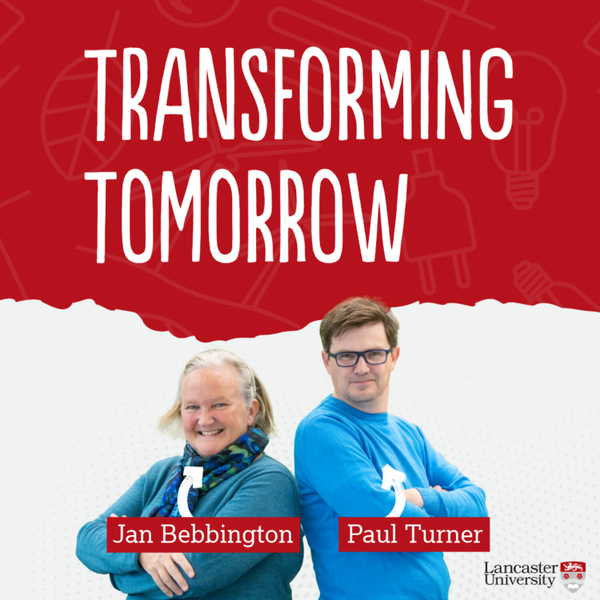
Hosts Jan and Paul bring insight, perspective, and not a little amount of disagreement, to all the subjects, helping you find the message among the madness.
Join us every Monday to uncover new insights and become a little more inspired that you can make a difference.
You can find transcripts for most episodes at: https://www.lancaster.ac.uk/pentland/resources-for-education-and-practice/transforming-tomorrow-podcast/transcripts/
Send your questions on any of the issues we discuss in Transforming Tomorrow to [email protected] or fill in our feedback form here: https://forms.office.com/e/7Bw4rDiRDt
Find out more about the Pentland Centre and its work here: https://www.lancaster.ac.uk/pentland/
Meet the Hosts

Professor Jan Bebbington is the Director of the Pentland Centre for Sustainability in Business at Lancaster University. Jan is an expert on accounting, benchmarking (to her co-host’s annoyance), and how business and sustainability intersect.
Jan loves nature and wants to protect it – and hopes she can change the world (ideally for the better). She is also motivated to address inequality wherever it is found and especially to eliminate forced, bonded or child labour. Transforming Tomorrow is one small step on that quest.

Paul Turner is a former sports journalist who now works promoting the research activities in Lancaster University Management School – a poacher turned gamekeeper as his former colleagues would have it.
Paul has always been interested in nature and the natural environment – it comes from growing up in Cumbria – and has been a vocal proponent of the work of the Pentland Centre since joining Lancaster University. He does not like rankings and benchmarking, and is not afraid to say so.