
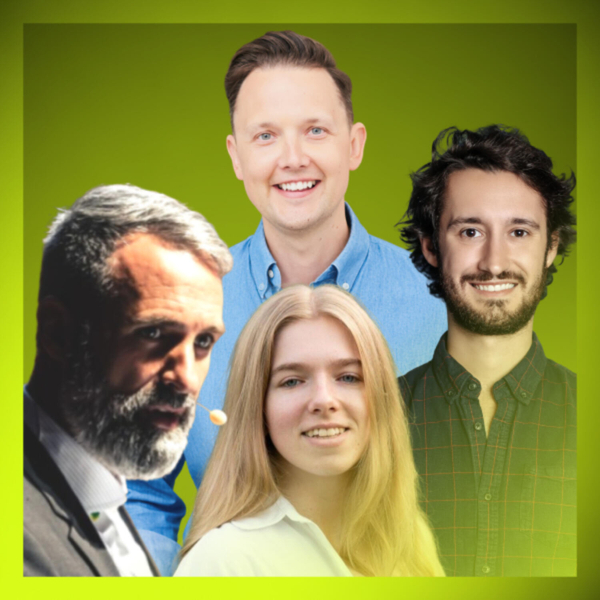
Recorded live from Intersolar Europe 2026 in Munich, this episode of What Matters brings together four voices shaping the next phase of solar development: David Trainavicius, CEO and founder of PVcase; Miguel Herrero, Senior Market Advisor at PVcase; Stephan Schindele, one of Europe's leading Agri-PV experts; and Madeleine Hill, a solar consultant and partner at Everoze. Across the conversations, one theme kept surfacing: solar demand is still strong, but the projects themselves are getting harder to build, finance, and defend. That means better decisions have to happen earlier, not after the fact.
David opens the episode with the founder's view of an industry outgrowing its subsidy-driven roots and leaning harder on data and AI to move faster without losing control. Miguel follows with an on-the-ground read of Intersolar's mood, the explosive rise of battery storage, and why an industry that looks like it is slowing down is, in reality, just getting more serious. Stephan then breaks down why Agri-PV is growing three times faster than solar overall, and why farmland, not desert, may be where most of Europe's next gigawatts get built. Finally, Madeleine brings the conversation to the ground truth of financing: what due diligence actually catches, why grid risk and module quality never stop being issues, and how Everoze's employee-owned, flat-hierarchy model shapes the way problems get solved.
Together, these conversations sketch a solar industry moving from ambition to execution. It is an industry trading hype for margin discipline, improvisation for standards, and guesswork for data, while still holding on to the optimism that got it here. PVcase helps developers, engineers, and consultants make these harder projects bankable from day one. Learn more at www.pvcase.com.
TAKEAWAYS
- Solar demand remains strong, but projects now face tighter margins, more scrutiny, and higher expectations from financiers
- AI is accelerating product development at PVcase, but data governance and client trust set real limits on adoption
- Despite talk of an industry slowdown, most companies at Intersolar reported being fully booked, signaling a maturing market rather than a shrinking one
- Contrary to common belief, well-designed Agri-PV (such as grazing systems) can have a lower levelized cost of electricity than conventional ground-mount solar
- Recurring project risks remain remarkably consistent: grid connection and curtailment, module quality, and poor data handoff between project stages
CHAPTERS
00:00 — Welcome to What Matters, live from Intersolar Europe 2026
00:59 — David Trainavicius on the mood at Intersolar and the "solar coaster"
04:41 — What separates the companies that survive from those that don't
05:33 — PVcase's origin story and building the full project workflow
07:09 — Balancing AI adoption with data risk and client trust
10:04 — Solar's maturity: from subsidies to bankable economics
13:32 — Miguel Herrero on market sentiment and the BESS boom
18:30 — Why building a battery storage business case is so complex
20:19 — Is solar in crisis, or just entering a new phase?
23:06 — Collaboration, data, and the push for industry standards
30:26 — Stephan Schindele on the fundamentals of Agri-PV
33:22 — Defining Agri-PV: from grazing land to fruit orchards
36:06 — Policy momentum and climate resilience for farmland
39:31 — Why Agri-PV could become Europe's standard within five years
44:04 — Debunking the cost myths around Agri-PV
47:00 — Madeleine Hill on due diligence and bankability
50:54 — Why solar and storage can no longer be assessed separately
53:17 — Growing pains: regulation lagging behind project scale
57:31 — The recurring risks: grid, curtailment, and module quality
1:02:27 — Diversity, employee ownership, and Everoze's collaborative model
1:08:10 — Closing thoughts: building solar right for the next phase
Watt Matters by PVcase
At PVcase, we’re on a mission to accelerate the world’s transition to sustainable energy.
That’s why we created the Watt Matters podcast - a must-listen series for developers, engineers, analysts, and decision makers shaping the future of large-scale solar.
Each episode tackles the tough realities behind why so many solar projects stall - and what we can do to fix it.
We bring together industry leaders to share strategic insights, practical tools, and real-world experiences.
Learn more at https://www.pvcase.com/